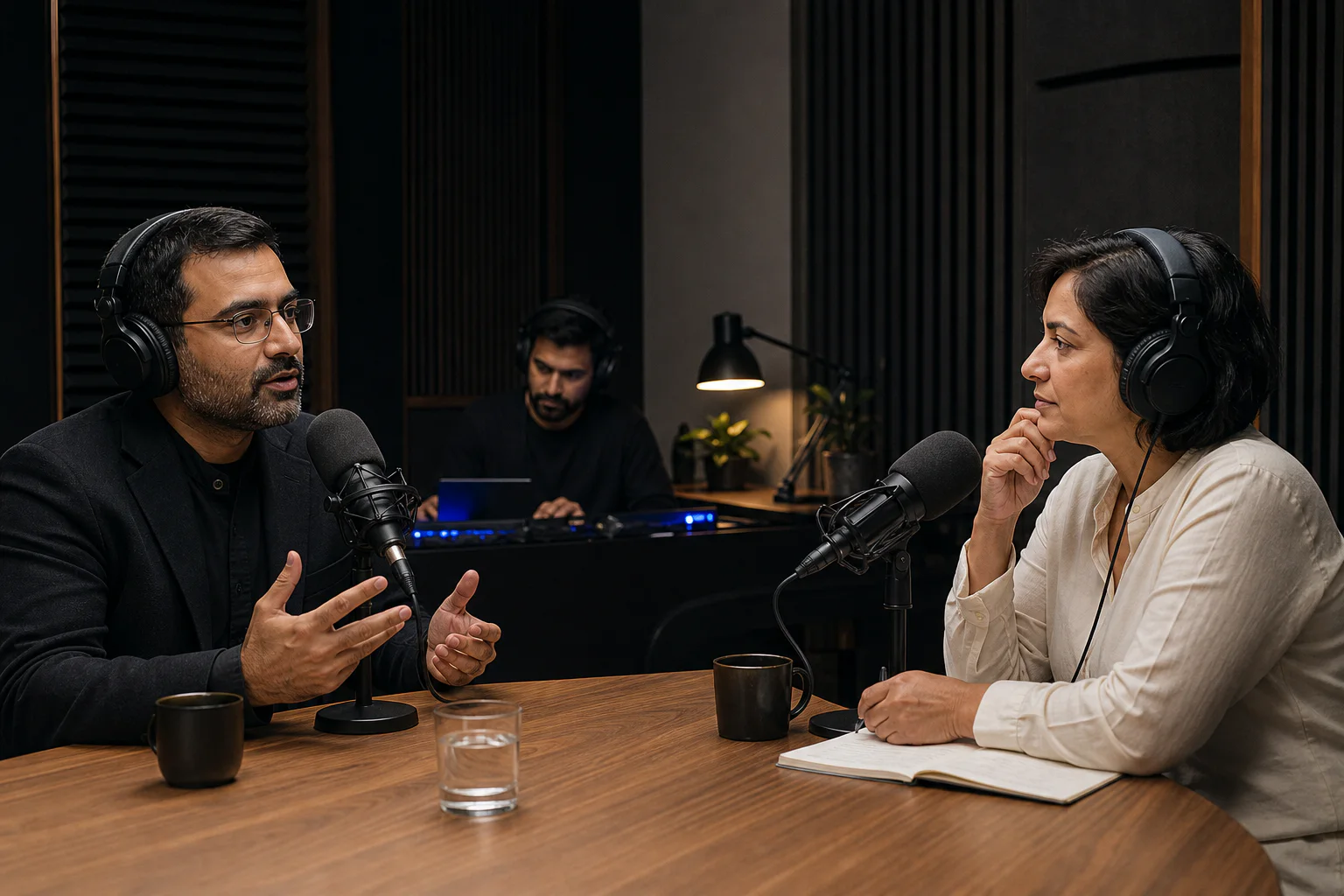

Founder podcast interview preparation should make the conversation more useful, not more rehearsed. Whether a leader is recording in a Hyderabad studio or joining an international show remotely, the goal is to arrive with a clear audience question, a defensible point of view, relevant evidence, and enough flexibility to listen well. The MESSAGE brief below turns that preparation into a practical decision guide without scripting away the human exchange.
The best preparation gives a founder clarity without taking the life out of the conversation.
Define the audience decision before drafting answers
Begin with the listener, not the founder biography. Ask what the intended audience is deciding, misunderstanding, or trying to improve. A healthcare leader speaking to hospital operators needs a different level of context from a technology founder speaking to product teams, even when both are discussing AI adoption.
Write one sentence that completes this prompt: ‘After this conversation, the right listener should be better able to…’ That sentence becomes an editorial filter. Stories, examples, and questions belong in the episode when they help the listener make that shift; impressive details that do not serve it can stay out.
Geography changes context but should not become decoration. A Hyderabad founder may need to explain local operating realities to an international audience, while an India-focused conversation can assume more shared knowledge. Decide which terms, institutions, currencies, regulations, and market conditions need a short explanation before recording.
Use the practical framework
- Who is the primary listener?
- What question are they trying to answer?
- What should they understand or do differently?
- Which local context needs explanation?
- Which topics are interesting but outside this episode?
Build the MESSAGE brief, not a word-for-word script
A script can make a leader sound certain while making the conversation feel closed. A better preparation document is a one-page MESSAGE brief: seven prompts that preserve accuracy and direction while leaving room for follow-up questions.
Keep each prompt to a few lines. The purpose is recall, not recital. If a claim depends on a number, date, product capability, policy, or research finding, verify it and keep the source beside the note. If it cannot be checked before recording, convert it into a clearly labelled observation or leave it out.
Read the brief aloud once. Spoken language needs shorter sentences, clearer transitions, and fewer nested ideas than written copy. Replace internal jargon with the words a customer, clinician, operator, or investor would actually recognise.
Use the practical framework
- M — Mission: the listener question this episode serves
- E — Evidence: facts, examples, and sources that support the view
- S — Stories: two moments that make the idea concrete
- S — Stance: the useful belief or trade-off the founder can defend
- A — Audience language: terms the listener already uses and understands
- G — Guardrails: confidential, regulated, speculative, or off-topic areas
- E — Extension: the honest next route after the episode
Prepare stories with evidence, tension, and limits
Thought leadership becomes credible when a point of view is connected to something observable. Prepare two or three stories with a simple spine: the situation, the tension, the decision, and what the experience changed in your thinking. A story can come from the founder’s own journey, a public market shift, or a common operating pattern; it does not need a dramatic outcome.
Separate evidence from inference. ‘We observed teams losing context between sales and delivery’ is different from claiming that a particular system will improve every company’s revenue. State what happened, what you believe it suggests, and what remains uncertain. This is especially important in healthcare, compliance, finance, and emerging AI topics.
Do not invent a customer example to make an answer sound stronger. When permission is absent, use an anonymised pattern only if it remains truthful and cannot identify the organisation. Otherwise, explain the principle with a hypothetical clearly introduced as a scenario.
Use the practical framework
- Situation: enough context for the listener to follow
- Tension: the decision, constraint, or competing priority
- Choice: what was considered and why one route was selected
- Learning: what changed in the founder’s view
- Limit: what the story does not prove
Set interview boundaries and practise the hand-offs
A useful conversation can still have boundaries. Before recording, identify confidential client information, employee details, unreleased product plans, personal subjects, active legal matters, regulated claims, and any topic the guest is not authorised to discuss. Share material boundaries with the producer early so the host can design a better route through the conversation.
Prepare a truthful bridge for questions that cross a boundary. A bridge does not dodge the subject; it explains the limit and moves to information the guest can responsibly provide. For example: ‘I cannot discuss that customer’s data, but I can explain the approval pattern we use before an automation goes live.’
Rehearse the opening answer, one difficult question, and the final takeaway aloud. Aim for a compact first response, then let the host decide where to go deeper. During the recording, listen for the actual question, pause when needed, and correct a statement in the room rather than hoping an inaccurate version disappears in the edit.
Use the practical framework
- Answer directly when the information is public and verified
- Qualify when the answer depends on context or remains uncertain
- Bridge when a boundary prevents a complete answer
- Pause when the premise itself needs clarification
- Correct the record immediately when a detail is wrong
Plan recording readiness and the post-interview content system
Confirm the practical details at least a day before recording: location or joining link, expected duration, audio and camera setup, clothing guidance, name and title, pronunciation, show format, release process, and the person who can approve factual corrections. For remote interviews, use headphones, silence notifications, stabilise the camera, frame at eye level, and test the actual connection and microphone rather than relying on a device indicator.
Plan accessibility and reuse before the conversation begins. Capture accurate names and specialist terms for captions, mark useful chapter moments, and decide whether the finished episode needs a transcript, summary, article, short clips, or quote-led assets. W3C guidance explains how transcripts support people who cannot access audio or video and recommends making them easy to find alongside the media.
After publication, review signals that match the original audience decision. YouTube Studio, for example, exposes impressions, click-through rate, traffic sources, watch time, and audience engagement. Combine platform data with qualitative signals such as relevant questions, qualified conversations, and whether the episode is still useful when referenced later. Do not turn a single episode’s performance into a guaranteed forecast.
Use the practical framework
- 24 hours before: verify logistics, profile details, and boundaries
- 30 minutes before: test sound, camera, connection, and environment
- During: listen, pause, clarify, and flag factual corrections
- After: confirm names, links, captions, transcript, and approvals
- After release: review audience-fit signals and document the next editorial question
Turn the framework into a focused first move.
Start with the decision, audience or workflow that matters. Then shape the right mix of strategy, creative direction, software and execution around it.
- A focused audience question and episode objective
- A concise MESSAGE brief for an unscripted conversation
- Credible stories with evidence, context, and limits
- Clear boundaries and truthful response bridges
- A recording, accessibility, distribution, and follow-up plan
Every engagement begins with context and scope. SOCIIUM does not guarantee rankings, performance outcomes, or business results.